Comment

Only Have 2 Dumbbells? Here’s a Simple Full Body Workout You Can Do at Home

You don’t need a full gym setup to get a great workout.

In fact, with just 2 dumbbells, you can train your entire body effectively — as long as you’re using the right movements.

This workout is designed to be simple, beginner-friendly, and easy to follow, while still giving you a proper challenge.

The Workout:

  • Walking Feet (Out, Out, In, In) x 25

  • Squat + Curl to Press x 15

  • Gorilla Rows x 20

  • Tricep Press to Squat x 15

  • Lower Back Front Raise x 15

Take your time, focus on control, and move at your own pace.

If you’re just starting out, go through it once.
If you want more of a challenge, repeat the full workout twice.

The goal isn’t to be perfect — it’s to get moving and build consistency.

👉 If you enjoy simple, effective workouts like this, check out our live sessions or explore more training options on the site.

Comment

Comment

2 Simple Core Exercises That Are Better Than Sit-Ups

If you’ve been told that sit-ups are the key to a strong core, you’re not alone.

But for many people, they can cause more strain than benefit — especially in the lower back and neck.

The good news? You don’t need them.

In this video, we focus on 2 simple and effective core exercises that build real strength, stability, and coordination.

Dead Bugs
This exercise teaches control through opposite arm and leg movement, helping your core stabilise your body while you move.

Overhead March
A great standing option that challenges your balance and forces your core to engage to keep you stable.

Both of these exercises are beginner-friendly and can be done at home with little to no equipment.

If your goal is to move better, feel stronger, and protect your body long-term — these are a great place to start.

Give them a try and see how you feel.

Comment

Comment

Signs Your Core Is Weak (And What To Do About It)

Core strength is one of the most important foundations of movement, but it’s also one of the most misunderstood.

Many people assume they have a strong core simply because they can do basic exercises, but signs like poor balance, instability, or lack of control often tell a different story.

A weak core can affect everything from posture to strength and even increase the risk of injury.

In this workout, Cyn demonstrates four simple exercises designed to improve core activation, control, and stability.

The goal is not to train harder, but to train smarter — focusing on quality movement and consistency.

If you stay consistent with simple, effective exercises like these, you’ll begin to notice improvements not just in your core, but in your overall strength and coordination.

Train with us live every day through our online classes.

www.ricogroupfitness.net

Comment

Comment

4 Knee-Friendly Alternatives to Lunges

Lunges are one of the most common leg exercises in fitness programs, but for many people they can feel uncomfortable or difficult to perform.

Balance issues, previous injuries, or simple joint sensitivity can make lunges frustrating.

The good news is that lunges are not the only way to build strong legs.

In this short workout video, Cyn demonstrates four exercises that target the same major muscle groups — glutes, quadriceps, and hamstrings — while helping support knee stability.

The key message is simple:
fitness should adapt to your body, not the other way around.

By finding the right alternatives you can continue building strength, improving mobility, and staying consistent with your workouts.

If you enjoyed this session, you can train with us live every day through our online classes.

Visit our timtable for the full schedule and workout library.

www.ricogroupfitness.net

Comment

Comment

Knee Friendly Alternatives to Squats

Many people stop training their legs when squats begin to cause knee discomfort.

The good news is there are many effective exercises that strengthen the legs and glutes without placing excessive pressure on the knee joint.

Here are two simple movements you can add to your routine.

Exercise 1: Leg Raises

Perform this exercise slowly while keeping the moving leg straight and the toes pointing forward.

Recommended volume:

2 sets of 25 repetitions on each side.

This movement helps strengthen the hips and outer thigh, which support knee stability.

Exercise 2: Hip Raise With Clam

Lie on your back with your knees bent and feet flat on the floor.

Raise your hips while opening the knees slightly, activating the glutes and hips.

Recommended volume:

2 sets of 25 repetitions.

This exercise strengthens the posterior chain and improves hip stability.

Final Thought

Knee discomfort during squats does not mean you have to stop training your legs.

By strengthening the hips, glutes and supporting muscles, many people find their knee function improves significantly over time.

Consistency and proper movement are always more important than intensity.

Train with us live online:

👉 www.ricogroupfitness.net

Comment

Comment

Beginner Arm Workout You Can Do At Home

A lot of people ask the same question when they first begin strength training:

"I'm a beginner and want to tone my arms. Can you help?"

The good news is that you don't need heavy weights or complicated gym machines to start building strength.

This simple beginner arm workout uses light dumbbells and basic movements that help develop strength, coordination and muscle tone.

Beginner Arm Workout

Shoulder Press – 10 reps

Cross Curls – 20 reps

Tricep Kickbacks – 20 reps

Upper Back Rows – 15 reps

Wall Pushups – 15 reps

Complete two rounds at a comfortable pace.

Focus on good technique and controlled movement rather than rushing through the reps.

Strength training is one of the best things you can do for your health, especially as we get older. It helps maintain muscle, support joint health and improve everyday functional movement.

If you'd like more guided home workouts you can join our live training sessions or explore our online fitness programs.

Visit:

www.ricogroupfitness.net

Comment

Comment

5 Dumbbell Exercises for a Quick Upper Body Workout

If you have a pair of dumbbells at home, you already have everything you need for a great upper body workout.

In this short sequence, Cyn demonstrates five simple exercises that target the major upper body muscle groups.

The movements include:

• Shoulder circles
• Tricep kickbacks
• Bicep work
• Dumbbell pec movement
• High pull for the back

Each exercise is performed for 15 reps, focusing on controlled movement and good positioning.

The goal is not just lifting weight, but moving well and protecting the joints while building strength.

This type of simple dumbbell training can be done anywhere and fits easily into a quick workout routine.

If you only have limited equipment available, dumbbells are one of the most versatile tools you can use.

Train consistently, move well, and build strength over time.

– Rico Group Fitness

Comment

Comment

What To Do When You Can’t Lunge

If lunges aggravate your knees or feel unstable, that doesn’t mean you’re weak — it means you need smarter progressions.

This routine focuses on joint-friendly alternatives that build strength and control without unnecessary strain.

Perfect for beginners, over-40 clients, or anyone returning after time off.

Full routine below.

Comment

Comment

Glutes & Inner Thigh Strength Without Forcing Depth

If traditional lunges aggravate your knees, you don’t need to push deeper — you need better angles.

This routine combines glute and inner thigh work using controlled range and 45° foot positioning to reduce stress while still creating serious muscular activation.

Ideal for over-40 clients, beginners, or anyone rebuilding strength after time off.

Full routine below.

Remember: You don’t have to train like you’re 20 to get results.
Train smart. Train consistently.
— Cyn 💚

Comment

Comment

Signs Your Core Is Weak (And How to Start Fixing It)

If your core feels weak, unstable, or easily fatigued, the solution isn’t endless sit-ups.

In this beginner-friendly routine, Cyn demonstrates practical standing movements that help build real-world core strength, balance, and control — without getting on the floor.

These drills are ideal for:

  • Beginners returning to exercise

  • Joint-sensitive clients

  • Anyone wanting stronger everyday movement

👉 Full follow-along routine below.

Comment

Comment

Beginner Low-Impact Workout That’s Easy on the Joints

Looking for a beginner-friendly workout that won’t stress your knees or hips?

This low-impact full body routine helps build strength, coordination, and endurance while keeping joint load controlled and manageable.

It’s ideal for:

✅ Beginners starting their fitness journey
✅ Adults returning to exercise
✅ Anyone wanting effective, joint-friendly training
✅ Home exercisers short on time

👇 Full routine below.

🌟 Beginner Low-Impact Full Body Routine

This beginner-friendly, low-impact workout is designed to stimulate the cardiovascular system while building strength, coordination, and muscular endurance — all without excessive stress on the joints.

If high-impact training doesn’t suit your knees, hips, or lower back, this routine is an excellent way to keep progressing while protecting the body.

💪 Why This Routine Works

This session helps you:

✅ Build full body strength
✅ Improve coordination and rhythm
✅ Support posture and joint stability
✅ Increase muscular endurance
✅ Train effectively with minimal impact

It’s particularly useful for beginners, return-to-training clients, and anyone wanting a safer but still effective conditioning block.

🏋️ Equipment Used

  • Black weights: 5kg each

  • Blue weights (running arms): 3kg each

Choose loads appropriate to your current strength and always prioritise clean movement over heavier weight.

⚠️ If You Have Knee or Joint Concerns

If any movement causes discomfort:

  • Work only within your pain-free range

  • Reduce depth as needed

  • Gradually increase range as strength improves

  • Seek professional guidance if unsure

In many cases, joint discomfort during exercise is technical and improves quickly once the correct muscles are doing the work rather than the joints.

🔁 Programming Notes

  • Rest 60–90 seconds between movements if performing as a circuit

  • Perform 2–3 sessions per week

  • Can be used as a standalone short workout or combined with other sessions

Each round takes approximately 5–10 minutes, making it easy to integrate into a longer training plan if desired.

Strong, controlled movement always wins long term.

Enjoy!
Cyn 💚

Comment

Comment

Can’t Do Lunges? Try These 4 Smart Alternatives

If lunges bother your knees, hips, or balance — you’re not alone.

For many adults (especially 35+), lunges can feel unstable, uncomfortable, or simply too aggressive too soon. The good news? You can still build strong, functional legs without them.

These four movements help rebuild coordination, glute strength, and hamstring responsiveness — all critical for walking, balance, and injury prevention.

Let’s break them down.

1. Standing Heel-Toe Isometric

25 reps each leg

This simple but powerful movement helps overload the base glute while reinforcing the natural heel-to-toe pattern used in walking and running.

Why it matters:

  • Improves walking mechanics

  • Builds single-leg stability

  • Reinforces arm-leg coordination (crucial for balance)

  • Helps reduce trip risk as we age

👉 Coaching tip: Focus on smooth arm swing — many adults lose this natural rhythm over time.

2. L-Shape Side Taps

This drill challenges your ability to control the torso over a slightly bent knee while reaching the toe laterally and backward.

What it trains:

  • Lateral hip stability

  • Toe pointing control (often lost with inactivity)

  • Direction change mechanics

  • Balance under movement

This is what we call “trip-proofing” your movement.

👉 Keep your torso stacked over the working leg — don’t drift.

3. Standing Heel Kicks (Hamstring Curls)

50 reps alternating

In our experience, many hamstring issues don’t come from weakness alone — they come from poor firing speed.

Modern life trains us to sit… then suddenly move fast.

That mismatch is where problems start.

Benefits:

  • Improves hamstring reaction speed

  • Supports lower-back health

  • Reinforces safe sit-to-stand patterns

  • Builds posterior chain endurance

👉 Move with rhythm — not momentum.

4. Standing Butt Kicks

25 reps each leg

This final movement ties the sequence together by training the last arc of hip extension while maintaining strong base-leg glute activation.

Why we include it:

  • Reinforces hip extension

  • Builds rear-chain coordination

  • Completes the lunge pattern safely

  • Improves single-leg control

👉 Keep the standing leg tall and stable.

✅ The Bottom Line

You don’t have to force lunges to build strong, capable legs.

Smart, controlled standing drills like these can:

  • Improve balance

  • Strengthen glutes and hamstrings

  • Reinforce walking mechanics

  • Reduce injury risk

Most importantly — they help you stay confident and capable in everyday movement.

Want full structured, knee-friendly workouts?
👉 Join the Rico Group Fitness members library for guided sessions designed for real bodies and real life.

Comment

Comment

5 Signs You’re Sitting Too Much — And How to Fix Them

Modern life has dramatically increased the amount of time we spend sitting — at desks, in cars, on couches, and behind screens. Unfortunately, prolonged sitting can weaken key muscle groups, restrict mobility, and lead to ongoing joint discomfort if left unaddressed.

The good news? Your body gives warning signs early — and with the right movements, you can reverse many of the negative effects before they become long-term problems.

This short routine targets the muscles most affected by excessive sitting while restoring natural movement patterns.

✔️ Sign #1: Tight hips and restricted leg movement

When we sit for long periods, the hip flexors tighten and the glute muscles become underactive. Over time, this alters posture and reduces walking efficiency.

What to do:
Focus on controlled leg raises while keeping the working leg straight and aligned with the torso. This helps reactivate the outer glute muscles and improve hip stability.

Recommended: 25 reps each leg.

✔️ Sign #2: Weak glutes and poor pelvic stability

The glutes are designed to be one of the strongest muscle groups in the body, yet prolonged sitting often switches them “off.” When this happens, surrounding joints — particularly the hips, knees, and lower back — are forced to compensate.

What to do:
The hip raise is one of the most effective ways to reverse the muscular effects of sitting. Drive the hips upward with control and focus on full muscle engagement.

Pair this with a clam movement to activate the inner thigh muscles, which play a critical role in stabilizing the knee during everyday walking mechanics.

Recommended:
2 rounds of 25 repetitions.

✔️ Sign #3: Reduced mobility when getting up or moving

If you feel stiff when standing or notice your movement isn’t as smooth as it once was, this is often a sign that your muscles have adapted to inactivity.

The key is not intensity — it is consistency.

Small, targeted drills performed regularly can dramatically improve how your body feels and functions.

How Often Should You Do This Routine?

Perform these drills 2–3 times per week to restore muscle activation, improve mobility, and support healthier movement patterns.

Each round takes only a few minutes — making it easy to integrate into your existing training or use as a quick standalone session.

A Quick Reminder

Always work within a pain-free range of motion and progress gradually as your strength improves. If discomfort persists, seeking professional guidance can help identify technical adjustments that ensure the muscles — not the joints — are doing the work.

Move better. Feel stronger. Stay pain-free.

If you’re ready for structured, full-length workouts designed to support strength, mobility, and longevity:

👉 Join our members library here:
https://ricogroupfitness.net/become-a-member

Comment

Comment

🦵 Knee Friendly Cardio

Low-Impact Conditioning for Strength, Fitness & Joint Confidence

This knee-friendly cardio session is designed to improve cardiorespiratory fitness, posture, strength, and coordination while keeping joint stress to a minimum.

It’s a challenging yet controlled combination that supports fat burning, pelvic floor activation, hip–knee mobility, and full-body coordination, making it ideal for anyone who wants to stay fit without aggravating their knees.

🎯 What This Session Trains

  • Cardiorespiratory endurance

  • Postural realignment and core stability

  • Muscle strength and definition

  • Fat burning and metabolic activation

  • Pelvic floor and stabiliser engagement

  • Hip–knee mobility and coordination

⚙️ Equipment

  • Optional dumbbells: 5kg / 11lb (blue weights shown)
    This session can also be performed bodyweight only.

⚠️ If You Have Knee Issues

If you have knee discomfort, this session can still be used safely by:

  • Working strictly within a pain-free range of motion

  • Limiting depth, speed, or intensity that triggers discomfort

  • Gradually increasing range and effort as strength improves

In most cases, knee pain during exercise is technical rather than structural. One well-chosen feedback session with a qualified trainer can often correct movement patterns so the muscles take the load instead of the joints.

If you’re unsure how to approach a trainer without being sold a long-term program, feel free to reach out — I’m happy to help you navigate that.

🔁 The 5 Exercises (In Order)

1️⃣ Invisible Skipping Rope

50 repetitions

An underrated but powerful movement with many benefits:

  • Gentle, progressive impact tolerance

  • Upper–lower body coordination

  • Rhythmic breathing and posture control

  • Dynamic core stability

  • Wrist mobility and lower-leg conditioning

Coaching cues:
Stay tall, shoulders back, wrists make small circles in time with the jumps. Stay off the heels and push through the balls of the feet.

2️⃣ Repeater Knees

50 repetitions each leg

A highly effective cardio and leg activation drill that excites the muscles quickly.
Benefits include:

  • Reciprocal arm–knee coordination

  • Glute stabilisation to offset prolonged sitting

  • Strengthening walking and leg-exchange mechanics

  • Lower-body toning and fat burning

Tip:
Think opposite elbow to opposite knee. Bend the standing leg only within a pain-free arc.

3️⃣ Invisible Ball Slams

25 repetitions

A full-body coordination exercise disguised as cardio.
The biggest benefit comes from direction changes, where kinetic energy creates progressive overload.

Coaching cues:
Feet just outside shoulder width, small squat, arms move as if throwing and slamming a ball. Increase squat depth if you want more leg involvement.

4️⃣ Running Arms

30 seconds

A classic upper-body cardio movement that trains:

  • Shoulders, chest, arms, and upper back

  • Core engagement and posture

  • Cardiorespiratory endurance

Key points:
Maintain a 90-degree bend in the elbows, pull elbows back behind the ribs, keep muscles tight, and breathe with the movement. Alternate leg stance each round if desired.

5️⃣ Rope Pulls (Alternating Arms)

50 repetitions

Excellent for:

  • Bilateral coordination

  • Upper–lower body timing

  • Upper-back strength and postural balance

  • Core engagement with rhythmic knee bending

Execution:
Reach high with one arm, “grab the rope,” and pull down to waist height. Alternate arms smoothly while keeping the core engaged.

🧩 Session Structure

  • Perform all exercises in order

  • Rest 60–90 seconds between exercises

  • Repeat 2–3 rounds

  • Approx. 5–10 minutes per round

  • Frequency: 2–3× per week for up to 6 weeks

This routine can be used as:

  • A standalone knee-friendly cardio session, or

  • A conditioning block within a full training day

🔥 Fat Loss Context

Fat-burning processes generally increase after around 25 minutes of continuous activity.

  • General conditioning sessions: ~20 minutes

  • Fat-loss-focused sessions: 40–60 minutes

Combine this session with another workout if fat loss is your primary goal.

💬 Final Note

This routine is about confidence through movement — training your body to handle rhythm, coordination, and load without fear or joint stress.

Stay patient, work within your limits, and let consistency do the heavy lifting.

Cyn

Comment

Comment

Calisthenics- A form of training that can change your life!

System Athletica is all about calisthenics training. But what exactly does CALISTHENICS mean and what’s it all about?

It's basically the name given to repetitive exercises that use the resistance of your own body to build strength, increase flexibility and burn body fat.
Minimal equipment is needed for calisthenics and can be performed anywhere there is a floor and space. One of the most beneficial aspects of training this way is increased endurance, as with most exercises, you will work almost every muscle in the body. The moves in calisthenics are natural ones that are far better for your joints. Many people who weight train suffer from joint pain because there are exercises that use joints in an unnatural way.

95134259_2953284471416342_5795192741063294976_o.jpg

Personally, this is my favorite style of training. I always feel so good after a System Athletica class. The thousands upon thousands of squats, lunges, knees, glute work, taps and heels that I've rep'd out in this class have given me so many benefits.
The strength in my legs are all thanks to this style of training. It's what strengthened Justin's knees after suffering pain for many years.
We cannot recommend calisthenics enough!
System Athletica- Mondays 6pm & Wednesdays 9:30am.
Do yourself the biggest favor and add these classes to your training regime.
Your body and your life will change for the absolute better.

Support our content

Comment

Comment

Bits about pushups

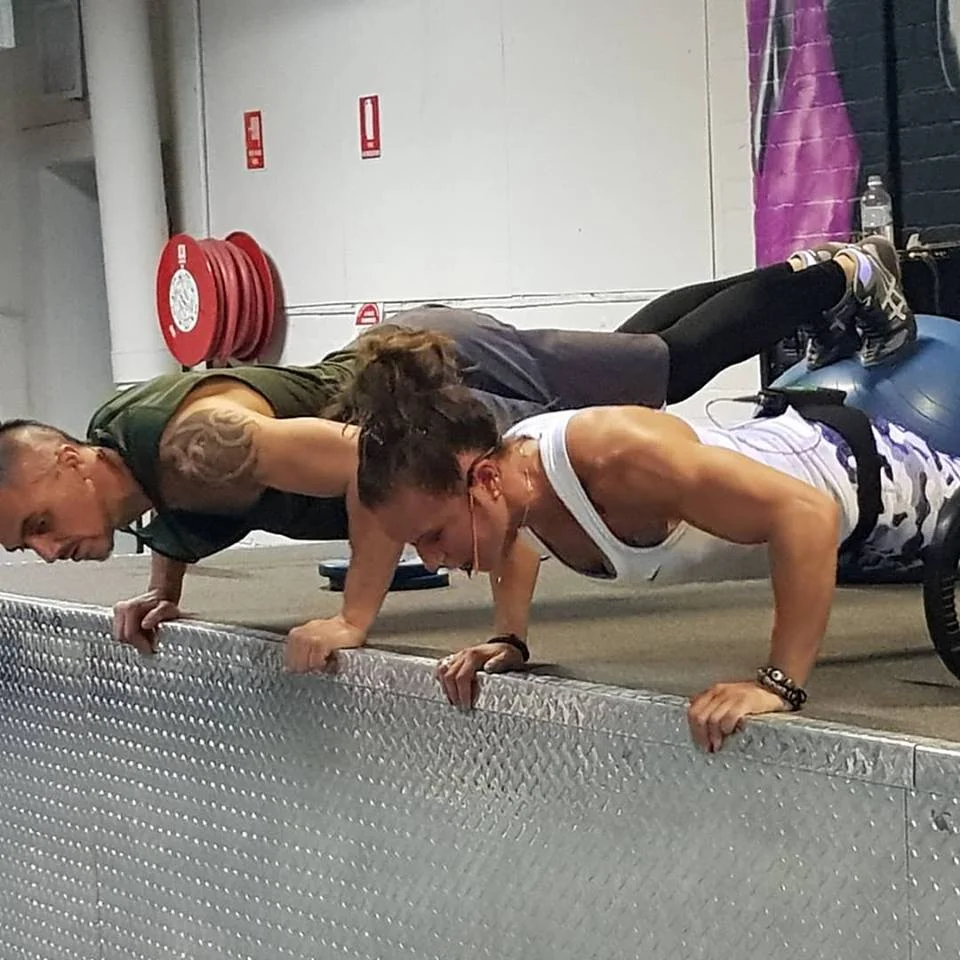
Justin and I do pushups in almost every single class. Love them or hate them, you can't deny how good the ol' push up really is. Why you ask??

40371603_1877948835616583_3103950934716186624_n.jpg

Well... as you lower your body to the floor and that familiar "burn" starts to kick in, I bet the last thing you're thinking is "wow! This is activating every single muscle in my body!" However, this is probably one of the top benefits of the push up. Major muscle groups like the biceps, triceps, stomach muscles, anterior deltoids and the lower body are activated to support your body while stabilizing your movements.

Classified a compound exercise (meaning multiple muscles are called upon), the most underrated benefits of doing pushups is the stretch it provides your biceps and back. As you lower yourself down, your back muscles are effectively stretched and when you push yourself back up, your arms get a full stretch as they extend. 

40410416_1877948768949923_3132840731585019904_n.jpg

And going back to it being a compound exercise, when you simultaneously engage large muscle groups, your heart must work harder to deliver oxygen-rich blood to muscle tissue. Ultimately, this activity results in an effective cardiovascular exercise which supports heart health and promotes the reduction of stored body fat. Not to mention: the pushup gives you a full body workout, helps create balance, stability and muscle density, you can do them anywhere, they burn calories, easy to modify, and the best part is... they are free!!

I could boggle your mind some more but I think you get the jist of why you need to do your pushups!!

J & I will do around 150 per day... how many do YOU do?!? 

Donate to Support our content

Comment

Comment

Mild Oxygen Hyperbaric Therapy at the Stevenson’s & what does it do?

chamber1.png

In our quest to maintain great health for ourselves and our trainees, we invested in a Mild Hyperbaric Oxygen Therapy chamber (MHBOT). I first saw one of these at a fitness convention in 2004 and wanted one there and then, but when I tried to finance it I was knocked back because I was a broke personal trainer in a new city. Fast forward to today and I am “livin la vida loca” with my HBOT.

Basically when you sit in a pressured environment with an increased (pure) oxygen supply, your body reorganizes itself on a cellular activity by up-regulating anti-inflammatory genes and down-regulating inflammatory genes. The pressure acts as a gas and because our body is made up of gasses on a microscopic scale, every cell must contract giving a "workout" response on a cellular level. As we know from the training cycle, the body runs on oxygen, so when we saturate the body with oxygen, we are ultimately giving our cells a nice mild workout with excellent hydration.

Some of the results from using MHBOT are amazing and seem to be full of it (B.S) - but who am I to disregard another persons tangible result if they are living proof of the process working? I will only ever share what I have seen with my eyes and the results I have felt are the following - which I CANNOT say are placebo or not - however I do not care, I just know they happened since using the chamber.

  • Better sleep - more restful. Ease of getting TO sleep is arguable, I think I go down heavier but there is a touch of increased mental activity before sleep kicks in but I have been getting up less during the night - again I am not sure if this is the chamber but I can say with confidence my sleep has been effected positively.

  • Faster recovery from training, this this is a text book response due to the anti inflammatory nature of the therapy but It is only subtle. I notice it because I have done 100's of thousands of hours of training so yes it works.

  • Old joint pains started lessening. I have knee issues from poor athletic form in my teens and early 20’s and have persistently tried to "fix" them non-surgically for the past 15 years. I can say with confidence that my knees have been getting progressively better. Deep squatting was a trip down knee burn lane but since using the chamber I have slowly gained confidence and can hit rock bottom again with half the burn I used to feel - and it is getting better as the weeks go by. Please note this was progressive. I did feel a marked improvement after my first session though.

  • Strength increase - weight lifting capacity went up. Plain and simple I got a 5% strength increase in a few weeks. Did I actually get "stronger" or was it because my body feels better so my trust in it to operate at high levels increased? I don’t know but it happened, and if you know me you will know I am very careful with weight lifting so a 5% increase is huge.

  • Mental clarity - this is a big one, I take in tremendous amounts of info every day from multiple sources and I often found myself stuttering and sometimes stumbling mid sentence like my words couldn’t catch up with my thought and since using the chamber this has changed big time. I feel mentally sharper is the best way to explain it.

  • Energy and fatigue cycles are more noticeable. Another strange one, they all spout about the energy high you get but no-one says anything about the fatigue. I find myself getting very tired when sleep time rolls around. Training felt different in the beginning too, I felt myself fatiguing faster because my output went up which was not expected. Felt like not being fit which was humbling and interesting at the same time.

  • Increased sense of well-being. I see this word combination ("well being") around a lot and often wonder what the heck it actually means to the point it seems like a BS euphemism, but I will use it here in this context because I cannot explain this effect any other way. I am sometimes a grumpy bugger who can be somewhat asocial, this is something I work on constantly so to feel "nicer" without having to remember to be was something that stuck out. I have noticed a marked improvement to my overall sense of feeling "good". This is not to say that feeling “bad” does not happen anymore - of course it does - but you really notice it when it does. To me this is a good thing.

So these are the biggest things that have happened to me with regular usage. I try to use it every day for about 70 minutes and find with each session the benefits I have just mentioned subtly amplify and last. I am not sure how long random session effects last - an interesting side-note is when people are asked about whether it "works" or not is they often do not initially notice the differences. It is the husband/wife/kids/etc that notice the changers more than the individual which I always find fascinating. If we do not notice changes but our loved ones do, what else are we missing?

If you want more science in Mild Hyperbaric Oxygen Therapy check out the internet but be warned, most if not all of the medical case studies refer to HARD Hyperbaric Oxygen Therapy which is completely different to mild. Most of the info on mild has been copied and pasted from a few major sites on HARD therapy so this obviously taints the info which is why I chose giving my personal opinion instead of a whole bunch of well conceived and placed words which are actually falsely misleading when they are using HARD therapies medical doctrine to promotes MILD’s benefits.

I wish I could point you in the right direction for medial research data on MILD’s benefits but I cannot. All I can say is that it works for me, thousands of professional athletes like Lebron James, professional cyclists sleep in them, home doctors have "cured" loved ones, tens maybe hundreds of thousands of regular folk swear by the benefits and I am becoming one of those.

Comment

Comment

Recovery @ Cyn

40752831_1884968708247929_6622674699522408448_n.jpg

I'm not always "Hitler" in session, I can massage too!!

I try and get my clients to have a recovery session every 6-8 weeks. The body is like a car; it needs to be serviced regularly in order to keep working and moving. 

My recovery sessions consists of stretching, mobility work, balance, massage and sometimes even a sauna. 

The client leaves feeling fresh and revitalized bacause the session prompts the release of endorphins (the brain chemicals and neurotransmitters that produce feelings of wellbeing) Levels of stress hormones such as adrenaline, cortisol and norepinephrine which can impair the immune system are also reduced. 

A Rico Recovery session leaves you with reduced muscle tension, improved circulation, stimulation of the lymphatic system, reduction of stress hormones, relaxation, increased joint mobility and flexibility, improved skin tone, improved recovery of soft tissue injuries, heightened mental alertness and reduced anxiety and depression. 

My clients say that my massages ROCK because I know exactly where to target. Alot of massage places will only target the usual areas; back, legs and shoulders. I'll get into the little areas that tend to be forgotten about. Places like the ITB, the achilles, tibialis anterior, sternocleidmastoid, the traps and teres major and minor. 

And I target these areas because I know that's where I usually get sore from training. 
So... you tired? Stressed? Sore? Or just need some time out to yourself? Come see me... for a small person I got some pretty sharp elbows!!

Comment

1 Comment

Why you gotta bounce

When we bounce on the trampoline we are working calisthenics (using our own bodyweight) and against the constant force of gravity, which runs resistance through all 50 trillion cells of our body. As you are reading this, also consider that "weight", by definition, is mass X acceleration. 

IMG_4586.JPG

Rebounding offers 2 extra forces related to velocity or change of velocity and the forces are called acceleration and deceleration. (Uses car driving analogy accelerator and braking to decelerate) Generally these forces run along straight, linear pathways, in rebounding we manipulate them to travel vertically or straight up. This, along with the other forces of gravity and velocity variables introduces the physiology to a whole new environment it must adapt to.

Traditionally, working vertically can be eventually problematic as the only other modalities are basically running and sports which require many years of technique and are often difficult to reach high exertion levels due to the potential damage these activities are known for (i.e. knee, back & foot issues). Rebounding takes all that away due to the mat & spring system, allowing the user to reach high levels of output/exertion without the compounding damage of a hard surface.

An important part rebounding plays is working relatively unknown part of our physiology called the lymphatic system. The lymphatic system is a system of tubes that start in the toes and fingertips and work up throughout the entire body. It is filled with one way valves which makes it so the lymph fluid only flows in one direction. The lymphatic system is sometimes known as the internal vacuum cleaner of the body. It has the capability of sucking up toxins, poisons, trash and metabolic waste making it possible for the oxygen and nutrients to get in and bathe the cells. The way to turn on the lymphatic system is by activating the one way valves , and the way you activate those valves is by an “up and down” activity or vigorous movement. Rebounding is one of the most efficient ways of achieving this.

IMG_2049 2.JPG

Because of the elevated lymphatic system activity, rebounding acts as a “cleansing” exercise which in our opinion places this style in a class of its own. The next key benefit of rebounding is the aerobic work, or the ability to breathe deeply and take in greater quantities of oxygen which has many profound and far reaching crossovers too many to list here. Next we come to the resistance, which comes in the form of gravity. Because gravity is an invisible force which passes through all 50 trillion cells of the body, each one of these must contract in order “keep the body together” so to speak (If a cluster of these cells were NOT to contract, they would float away in space and time!).

Training the body on a cellular level creates elevates effects such as the connective tissues and muscles become stronger and work as a compete unit, the vital organs get conditioned allowing them to function more efficiently due to the increased lymph fluid activity. We also get to stimulate  the balancing mechanisms of the body; the vestibular system, the anti-gravity muscles and the proprioceptors of the joints, so that you develop a greater sense of balance, coordination, rhythm, timing dexterity, and kinaesthetic awareness. Because of all these benefits, we have found that the entire body will function much easier.

Point of the story, if you have a history of eating "garbage" food, your "garbage collectors" are regulated by the lymphatic system. The easiest way to stimulate this system into action is rebounding. What are you waiting for? Get bouncing!

1 Comment

Comment

A little about Rico Shadowbox

A great track from our favorite workout Shadowbox - the most misunderstood training style of all. When shadowboxing is performed correctly the results are staggering. Speed, coordination, balance, power, strength, agility, timing, flexibility, injury preventative, enhanced proprioceptive control, enhanced auditory recall, accelerated metabolic rate, the nerd list goes on. Our biggest hurdle is because shadow requires learning and skill development before these results occur, most people/trainers give up and move onto the more generic styles like circuits, weights etc. If you have never tried good shadowboxing, give this track a go. In the comfort of your own home just go for gold, heck even take your clothes off and do it nekked if thats your thing, we aint judging, just promoting participation. Check out our YouTube channel for many different styles of training material too, most people have never set foot in a gym let alone done an exercise to music class, so if you are worried about a family member/friend getting more and more overweight + sedentary, show em some videos and they can follow in their own time in their own space. Put in the time and you will be rewarded.

Boxing track from Shadowbox Mix 2 Cyn & Justin Stevenson Song: Lights & Thunder by Krewella, mix & choreography by Cyn Stevenson Follow Rico Group Fitness Facebook: https://www.facebook.com/Rico-Group-Fitness-179205145490969/ Instagram: https://www.instagram.com/ricogroupfitness/ www.ricogroupfitness.com.au www.ricogroupfitness.net

Comment